
The Danger of Assuming We Know Why People Behave The Way They Do

Recently, I bought the new edition of The Liberating Structures Fieldbook.

I’ve been using Liberating Structures since 2017.
I’ve taught immersion workshops around them.
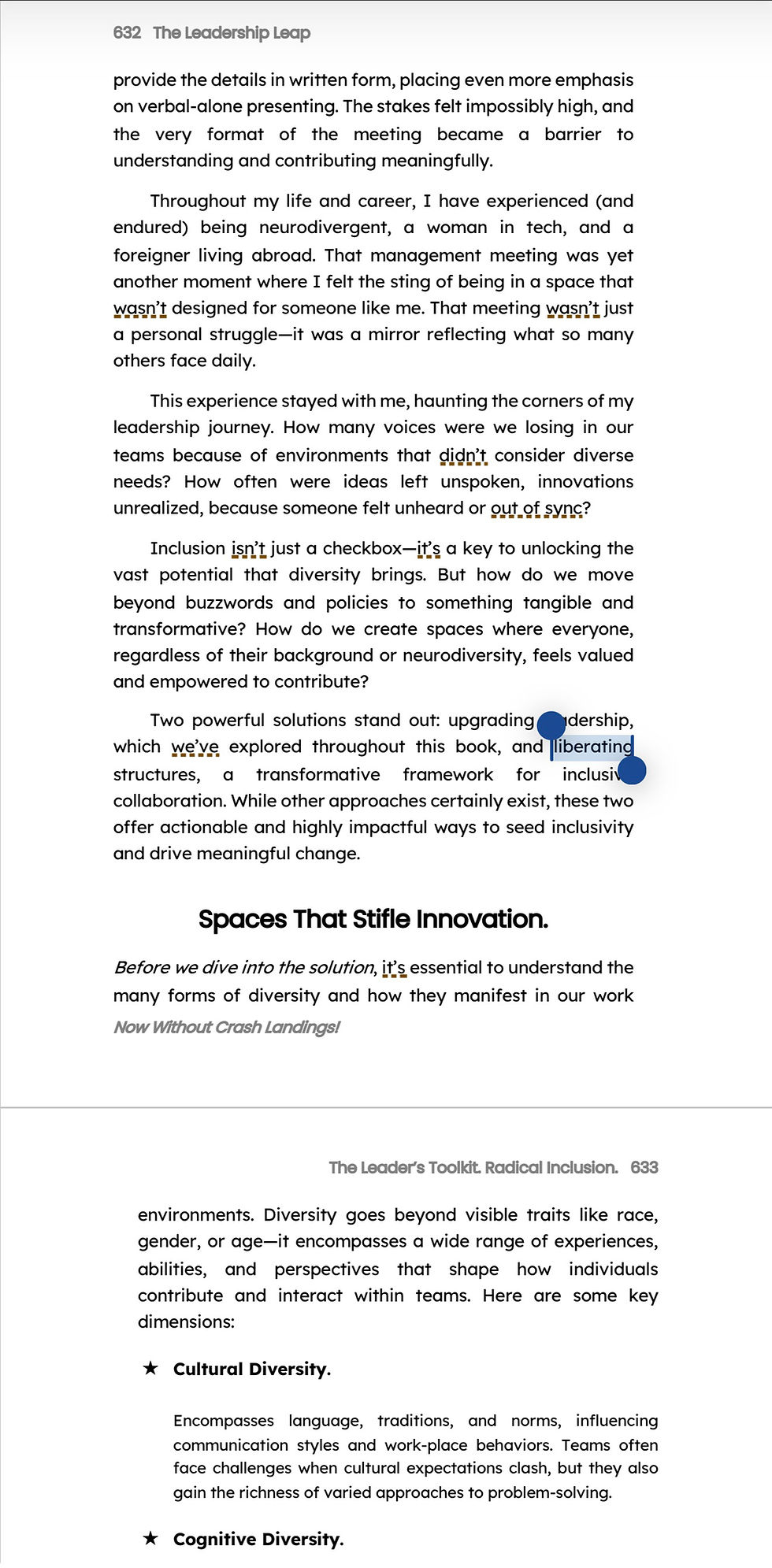
I even dedicated an entire chapter in my book, The Leadership Leap: Now Without Crash Landings, to them.
At first, I thought they were simply facilitation techniques.
A better way to run meetings.
A way to make workshops more engaging.
Over time, I realized they solve something much bigger.
They solve a human problem.
A problem I think is becoming increasingly visible.
We have become incredibly fast at judging behavior.
Too fast.
We see someone interrupt.
We label them rude.
We see someone dominate a conversation.
We label them narcissistic.
We see someone stay quiet.
We label them disengaged.
We see someone overexplain.
We label them insecure.
We see someone become emotional.
We label them unstable.
In a world full of labels, personality frameworks, and sixty-second videos telling us exactly who someone is, we’ve become very comfortable believing we know why people behave the way they do.
We see behavior.
We assign a cause.
We move on.
But what if behavior is actually one of the least reliable pieces of information we have?
What if behavior is merely the smoke while the fire underneath is entirely different for every person?
This realization hit me unexpectedly this weekend.
🐉
A Story About My Aunt
I didn’t grow up with my biological aunt.
I met her in my twenties.
At the time, I absolutely loved how much she talked.
I had spent most of my life not knowing a much about my biological family.
I wanted stories.
I wanted history.
I wanted information.
I wanted to understand where pieces of me came from.
Her talking felt like a gift.
I appreciated every detail.
I loved learning about my roots.
I’ve only seen her a handful of times over the years.
This weekend, she visited my home for three days.
And something felt different.
Nothing terrible happened.
There was no conflict.
No argument.
No cruelty.
Yet by the end of the weekend, I felt heavy.
Almost sad.
For three days, most conversations revolved around her.
My children slowly disappeared.
I slowly disappeared.
After three days, she didn’t know much about my children, their hobbies, their personalities, or their worlds.
Strangely, she didn’t know much about my life either.
And immediately, my brain did exactly what all human brains love to do.
It started searching for explanations.
Is she gifted?
Does she have ADHD?
Could this be loneliness?
Could it be anxiety?
Trauma?
Narcissism?
I wanted a label.
Not because I wanted to judge her.
But because labels can temporarily soothe discomfort.
They make complexity feel manageable.
Yet the irony is that this entire weekend was reminding me of the opposite lesson.
People are rarely that simple.
🐉
Perhaps She Didn’t Change. Perhaps I Did.
I don’t think my aunt changed.
I think I did.
Twenty-eight (around the first time I met her) or even twelve years ago (the last time I met with her), I was still comfortable disappearing inside relationships.
I used to magnify other people.
I made myself smaller so others could become larger.
I listened.
I adapted.
I disappeared.
And I thought that was kindness.
The last ten(ish) years have changed me.
I’ve healed.
And over time, I’ve come to define healing differently than I used to.
Healing is not forgetting.
Healing is not pretending the past never happened.
Healing is not becoming someone new.
To me, healing is letting go of the attachment to the past while keeping the lessons with you.
Because attachments can quietly control us long after an event is over.
Sometimes we think we’ve let something go, but it still shows up in everything we do.
The way we communicate.
The way we choose relationships.
The way we tolerate things.
The way we shrink ourselves.
The way we overcompensate.
Healing isn’t erasing those experiences.
It’s learning from them without allowing them to continue driving the vehicle. I wrote all about this two days ago in another blog post.
And perhaps that’s what happened this weekend.
I wasn’t simply observing my aunt.
I was observing the distance between the woman I used to be and the woman I am becoming.
Twelve years ago, I needed information.
Today, I need reciprocity.
Twelve years ago, I was comfortable being invisible.
Today, invisibility hurts.
Both versions of me were valid.
But they needed different things.
And maybe that is one of the strangest things about growth.
It changes what hurts.
🐉
Then Motherhood Added Another Layer
I don’t think the deepest pain came from me becoming invisible.
I think it came from watching my children become invisible.
That changed everything.
As a mother, a protective instinct woke up.
I saw them patiently listening.
Waiting.
Trying to enter conversations.
Only to slowly retreat.
And it hurt.
Not because I need my children to be the center of attention.
But because every human deserves to be heard, seen, respected, and valued.
Especially children.
I know what invisibility feels like.
I’ve lived it.
And once you’ve experienced it, you become highly sensitive to it.
Even when nobody else notices it.
🐉
The Uncomfortable Truth: I Also Talk A Lot
This is where the story becomes complicated.
Because if I’m honest, I can also talk a lot.
Especially when I become excited.
My brain doesn’t move in straight lines.
Leadership suddenly connects to psychology.
Psychology connects to engineering.
Engineering connects to humanity.
Humanity connects to childhood.
And suddenly my brain is holding twenty connections simultaneously.
I often describe my neurology as having both a think-in and think-out bandwidth.
Some people think first and then speak.
I can absorb while I am speaking.
I process while contributing.
I discover what I think while building upon someone else’s thoughts.
In many ways, my brain behaves more like collective jazz than sequential turns. 🎺🐉
And that’s also why interruption doesn’t bother me very much.
Sometimes I don’t even experience it as interruption.
I experience it as participation.
As collaboration.
As collective creation.
… Yet I know not everyone experiences it that way.
And that is where things become difficult.
Because not interrupting takes conscious effort.
Real effort.
It is not my default state.
I’ve heard the words
“don’t interrupt”
since I was a young girl.
Over and over again.
And if I’m honest, those words still hurt.
Not because the feedback is wrong.
Sometimes I absolutely need the feedback.
Impact matters.
But after hearing it your entire life, it slowly becomes something bigger.
I begin wondering if there is something fundamentally wrong with the way my brain works.
So I start policing myself .
Monitoring myself.
Shrinking myself.
Then another fear appears …
What if I become the person who makes others invisible?
(my whole life drive is creating inclusive spaces!)
And suddenly something strange happens.
Instead of talking too much, I stop talking altogether.
In new groups especially, this still happens to me.
I become hyperaware.
I monitor every sentence.
Every story.
Every contribution.
I become quiet.
Not because I have nothing to say.
But because I become afraid of becoming too much.
Perhaps that is a hidden burden many neurodivergent people quietly carry.
Not just the effort of adapting.
But the constant calculation.
Am I talking too much?
Am I too enthusiastic?
Am I too energetic?
Am I too much?
And that calculation is exhausting.
The irony is that people who know me well often describe me very differently.
My friends know how deeply I listen.
My colleagues know how much I see them.
The people closest to me know how much I remember details they shared months ago.
They know I genuinely care.
Which taught me something important.
One behavior alone tells us very little.
🐉
We Cannot Shop For Humans
Perhaps another lesson sits underneath all of this.
We cannot pick and choose traits from people like shopping at a grocery store. (one of my core life convictions)
If we want the gift, we often need to learn how to dance with the dragon that comes with it.
Sometimes the person who deeply sees others also occasionally interrupts.
Sometimes the highly creative person is chaotic.
Sometimes the reliable person struggles with spontaneity.
Sometimes the empathetic person becomes overwhelmed.
Sometimes the enthusiastic person accidentally dominates a room.
Sometimes the reflective person needs more time.
People are packages.
The dragon and the gift often arrive together.
Leadership is not about removing dragons.
It’s about understanding which dragons can learn to dance together.
🐉
This Is Why Inclusion Is So Hard
Talking a lot can come from culture.
Talking a lot can come from giftedness.
Talking a lot can come from ADHD.
Talking a lot can come from autism.
Talking a lot can come from loneliness.
Talking a lot can come from anxiety.
Talking a lot can come from trauma.
Talking a lot can come from excitement.
Talking a lot can come from insecurity.
Talking a lot can come from habit.
Talking a lot can come from narcissism.
Behavior is not a diagnosis.
Behavior is a clue.
And perhaps that’s why inclusion is so difficult.
Most exclusion isn’t malicious.
Most exclusion is lazy pattern recognition.
The fast thinker becomes rude.
The quiet thinker becomes disengaged.
The emotional thinker becomes irrational.
The reflective thinker becomes slow.
Meanwhile, everyone is quietly asking themselves the same question.
Do I belong here?
🐉
And This Is Why I Keep Coming Back To Liberating Structures
This weekend didn’t suddenly make me realize their value.
I’ve always known (at least since I’ve been introduced to them in 2017).
I’ve built immersion workshops around them.
And in those workshops, I intentionally did not limit practice to work scenarios.
Because this isn’t a workplace problem.
It’s a humanity problem.
In those workshops, we explored family dynamics.
Friendships.
Parenting.
Communities.
Dinner tables.
School projects.
Leadership meetings.
Because everywhere humans gather, the same dragon appears.
Who gets space to exist?
Who gets to fully be themselves without having to fight, shrink, adapt, monitor, or apologize for who they naturally are?
And perhaps that’s why I love these structures so much.
Not because they’re clever.
But because they distribute humanity.
The quiet person gets airtime.
The enthusiastic person gets boundaries.
The reflective person gets thinking time.
The energetic person gets opportunities to contribute.
Nobody has to fight for their existence anymore.
Nobody has to earn their belonging.
The structure itself creates inclusion.
As I flip through the new fieldbook, I see old friends like 1-2-4-All, TRIZ, Troika Consulting, Wicked Questions, Appreciative Interviews, Nine Whys, Ecocycle Planning, Wise Crowds, and newer structures built for uncertainty, complexity, and interconnected systems, and this makes me smile.

Because the world has changed.
But humans haven’t.
We still need to belong.
🐉
Perhaps This Is Also Why I Wrote An Entire Chapter About This In My Book
Because this was never about Agile.
It was never about workshops.
It was never about meetings.
It was never even about Liberating Structures themselves.
It was always about humanity.
The older I get, the more convinced I become that many capable people are exhausted.
Not because they lack competence.
But because they are constantly calculating themselves.
Am I talking too much?
Am I talking too little?
Am I too emotional?
Am I too direct?
Am I too enthusiastic?
Am I too analytical?
Am I too quiet?
Am I too much?
That calculation is expensive.
It consumes enormous amounts of energy.
Energy that could otherwise be used to create, innovate, collaborate, connect, and simply be present.
By the time many people enter a meeting, they’re already exhausted.
Not from the work itself.
But from adapting themselves to fit the environment.
The environment quietly dictates who gets rewarded.
Who gets heard.
Who gets airtime.
Who gets seen.
Who gets valued.
And that’s dangerous.
Because eventually diversity becomes performative.
We hire different people.
Then we reward identical behavior.
This is also why my leadership program exists.
Not to teach people how to become better versions of themselves.
But to help leaders understand themselves, understand others, and build environments where different humans can thrive together.
Because leadership isn’t about fixing people.
Leadership is learning how to hold complexity without reducing humans to labels.
🐉
The Final Dragon
At the beginning of this article, I thought I was writing about my aunt.
I wasn’t.
I was writing about three generations.
💚 My aunt.
💚 My children.
💚 Myself.
Three generations trying to communicate.
Trying to connect.
Trying to belong.
And perhaps that is the lesson.
We are all dragons carrying histories nobody else can see.
Some dragons learned to make themselves small.
Some dragons learned to make themselves big.
Some dragons learned to fill silence.
Some dragons learned to disappear.
And maybe none of them are wrong.
Maybe they’re all adaptations.
But again, the older I get, the less interested I become in asking:
Who is communicating correctly?
And the more interested I become in asking:
What environments allow different humans to coexist without constantly calculating their existence?
Maybe that’s the dragon we’ve been fighting all along.
Not each other.
But the exhausting effort of trying to earn our place around the fire.
Maybe leadership was never about leading others at all.
Maybe leadership has always been about creating spaces where humans can finally stop fighting for permission to exist.
💚🐉


Comments