
Courageous Conversations. Influential Conversations.

Courage is where leadership starts. Influence is what we learn to stack on top of it.
A note on privacy: this article grew out of a real Boost coaching session. I have deliberately changed enough facts, circumstances, roles, timing, organizational details, and identifying information to protect the privacy of the person involved. The leadership patterns and teaching are real; the identifying details are not.
Some coaching sessions are about helping someone solve the problem they carried into the room.
Others become teaching laboratories.
You start with one situation, peel back one layer, and suddenly you are working with values, convictions, personality, organizational systems, nervous-system responses, influence, power, ethics, accountability, and the question underneath almost every difficult leadership moment:
How do I remain fully myself in this room and still help us move?
This week, I had one of those sessions.
By the end, my wonderfully chaotic whiteboard was covered with circles, arrows, half-legible words, layers of personality, organizational priorities, ego, right-fighting, and one giant sentence:
MOVE A GROUP TOWARD ONE GOAL.
It looked messy.
The teaching underneath it was anything but.
Because the leader I was coaching had already learned something enormously important:
💚 How to have a courageous conversation.
💚 What she was running into now was the next layer.
How does she turn courage into influence?
Not by becoming more forceful.
Not by becoming more political.
And definitely not by learning how to make everyone agree with her.
By stacking a more sophisticated leadership skill on top of the courage she had already built.
The problem she brought into the room
She was several months into a leadership role.
Stretching.
Learning.
Managing people.
Managing expectations.
Managing a system that did not always behave in the way she believed good leadership should.
Recently, commercial pressure had led to conversations about people who did not currently have enough client work.
One possible solution involved ending someone’s employment much earlier than she believed was justified.
There was no meaningful performance issue.
There had not been months of missed opportunities.
The organization was under financial pressure.
And suddenly a human being’s livelihood had become one of the variables being considered.
She reacted strongly.
Not because she does not understand that businesses need to make money.
She does.
Not because she believes nobody should ever lose a job.
She does not.
The situation affected her because something much deeper was being touched.
She cried.
She felt it physically.
She carried it home.
She questioned whether she was equipped for the role.
She wondered how much power she actually had when the people above her could simply override her.
And somewhere inside all of that was another question:
If leadership means being asked to do things that feel wrong to me, how do I stay in leadership without abandoning myself?
That is a very different question from:
How do I give better feedback?
And that is where the session really began.
Before influence, we had to understand the explosion
I did not begin by teaching her how to persuade her manager.
First, we went inward.
What had actually been touched?
Which part of her had reacted so intensely?
We started naming values (her thrive needs)
🔥 Accountability.
🔥 Trust.
🔥 Authenticity.
🔥 And a strong thread of justice.
Then we moved another layer outward.
Convictions.
The beliefs we build around those deeper values.
Things like:
🔥 People are not numbers.
🔥 Money cannot be everything.
🔥 Even when difficult business decisions have to happen, we can still choose to act human.
Those are not the same thing as values.
That distinction matters.
A value might be:
🔥 Trust.
A conviction built around it might be:
🔥 A trustworthy organization follows through on commitments it makes to people.
The resulting behavior might be:
🔥 I challenge a decision that feels inconsistent with that commitment.
When we do not understand these layers, they collapse into one giant feeling:
THIS IS WRONG.
And when that happens, the dragon wakes.
🐉
That dragon is not the enemy.
The dragon is guarding something precious.
The work is learning what.
Self-regulation does not mean becoming emotionally flat
At one point she questioned whether she had regulated herself at all.
After all, she had cried for days.
Her body hurt.
She had felt overwhelmed.
I want to say this clearly because leadership culture still gets this wrong:
🔥 Self-regulation is not the absence of emotion.
A regulated leader is not someone who never cries.
Or never becomes angry.
Or never feels frightened.
Regulation means emotion does not remove your ability to choose.
You can cry and still have agency.
You can feel rage and decide not to attack.
You can feel fear and still speak.
You can be devastated and still refuse to abandon yourself.
The goal of emotional intelligence is not to become a smooth corporate surface.
It is to remain connected enough to yourself that you can still choose what happens next.
And she had.
She did not immediately resign.
She did not blindly comply.
She did not explode at her manager.
She processed.
She reflected.
Then she went back and had a conversation.
That mattered.
Because she had already developed the first layer.
🔥 Courage.
Courageous conversations are the start
When I teach courageous conversations, much of the early work is focused on self-awareness.

What am I seeing?
What am I feeling?
What do I need?
What am I afraid to say?
What boundary am I failing to hold?
What value feels violated?
What is the dragon protecting?
This work is essential.
Because if I cannot remain connected to myself under pressure, I will usually do one of four things.
🖤 Disappear.
🖤 Comply.
🖤 Explode.
🖤 Or perform leadership based almost entirely on what everyone else wants from me.
Courageous conversations help us stop doing that.
They help us say:
🔥 This is what I see.
🔥 This is what happened for me.
🔥 This is what matters.
🔥 This is what I need.
That is a huge developmental step.
And she had done it.
She had gone back to her manager.
She had explained why the situation affected her.
She had talked about trust.
She had talked about the people involved.
She had talked about the consequences she feared.
It was a courageous conversation.
And it was good.
But as she told me the story, I could hear the next developmental edge.
She had been courageous.
She had not yet been fully influential.
That is not a criticism.
That is the next stack.
Influential conversations ask a different question
Courageous conversations ask:
🔥 Can I stay with myself while I say what needs to be said?
Influential conversations add:
🔥 Can I understand you well enough to help us move?
That is a different skill.
And it requires something many leaders never really learn.
Not just self-awareness.
🔥 Differentiation.
Can I know who I am without needing you to be like me?
Can I understand your worldview without adopting it?
Can I remain anchored in my values without requiring you to validate them?
Can I stand in a room where you care deeply about something I barely care about and still use that knowledge to create movement?
That is where the work shifted.
So I started drawing.
On one side of the whiteboard:
HER
Her values.
Her convictions.
Her personality pattern.
Her triggers.
Then on the other side:
THE PERSON SHE NEEDED TO INFLUENCE
Not as a diagnosis.
Not as a fixed label.
A working hypothesis.
What does this person seem to care about?
What repeatedly gets their attention?
What appears to threaten them?
What gives them security?
What do they reward?
What frustrates them?
What do they seem to expect from other people?
We were no longer only exploring a difficult conversation.
We were mapping an influence system.
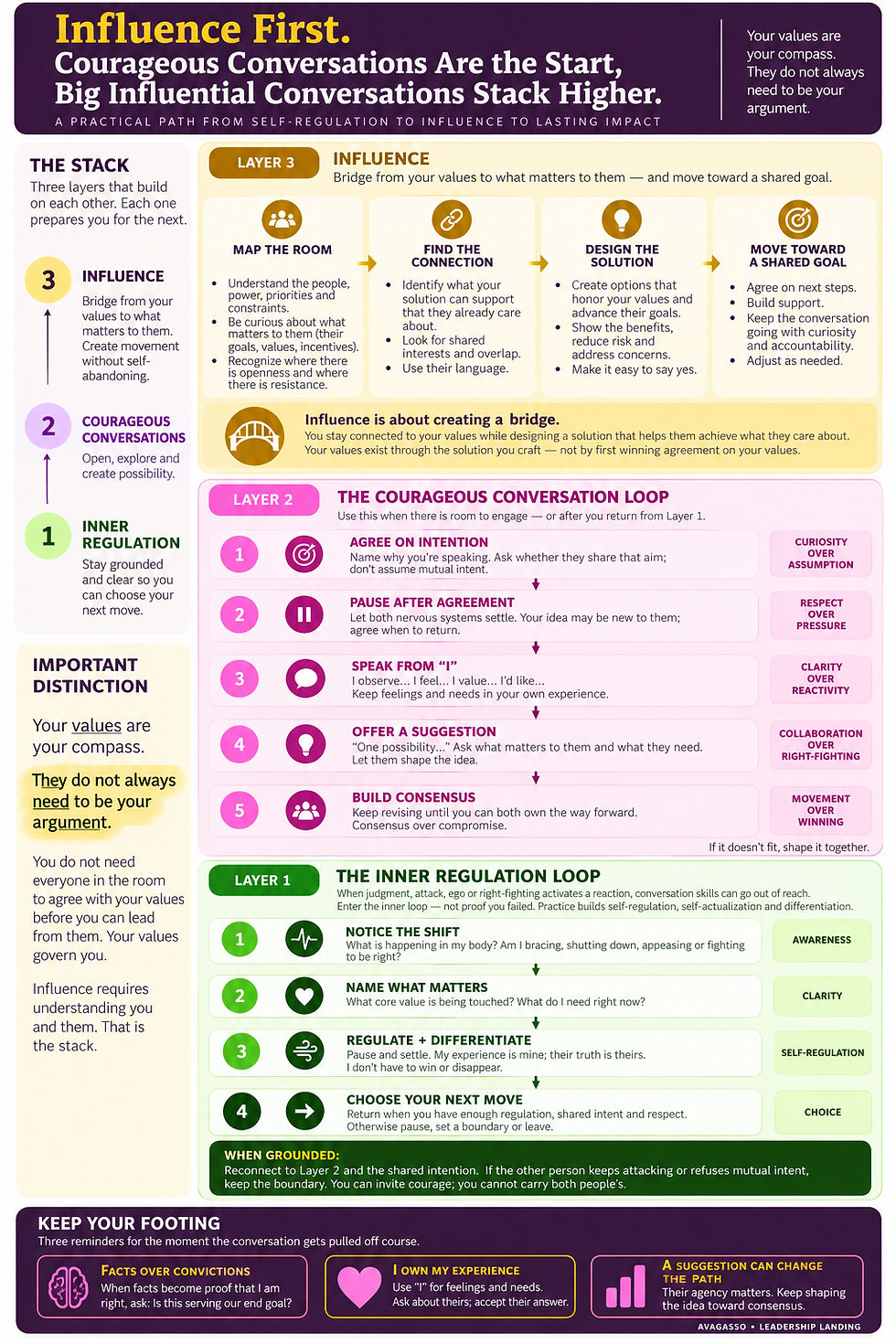
Right-fighting feels like leadership
This is where things got interesting.
Imagine one person entering the room carrying this conviction:
🔥 People are not numbers.
And another carrying:
🔥 The financial health of this organization must be protected.
The first person says:
🔥 We cannot treat people like spreadsheet entries.
The second hears:
🔥 You do not understand the business problem I am responsible for solving.
So they reply:
🔥 We are a commercial organization. Difficult decisions sometimes have to be made.
And the first person hears:
🔥 You do not care about people.
Now the conversation is no longer really about the decision.
It has become a battle between worldviews.
I call this right-fighting.
Right-fighting is seductive because it feels productive.
We think:
🔥 If I just explain this clearly enough, they will finally understand.
But often, the conversation has moved to the conviction layer.
And convictions sit close enough to identity that challenging them can feel like challenging the person.
Now ego enters the room.
And once ego is defending identity, the actual problem becomes background noise.
You are no longer discussing:
🔥 What should we do?
You are arguing:
🔥 What kind of person sees the world correctly?
That is not influence.
That is a dragon war.
🔥🐉
Influence does not require conversion
This became one of the biggest lessons I taught in the session.
She did not need her manager to suddenly believe:
🔥 People are not numbers.
She did not need her manager to adopt her worldview.
She did not need her manager to care about humanity in exactly the same way she did.
She needed to know:
🔥 What moves this person?
That is different.
And it requires a strong internal center.
Because when we are insecure in our own values, we often need other people to validate them.
We need them to say:
🔥 You’re right.
🔥 Trust matters.
🔥 Accountability matters.
🔥 People matter.
Only then do we feel safe enough to act.
But the more differentiated we become, the less we need that external agreement.
I can know what matters to me.
And I can still become deeply curious about what matters to you.
That is not surrender.
That is range.
Then we added the organization
There was still another actor missing from the whiteboard.
Not just:
🔥 Her.
Not just:
🔥 Them.
But:
🔥 The system they are both standing inside.
What does the organization value?
What does it reward?
What does it fear?
What language has credibility?
Which priorities are currently under pressure?
In the anonymized version of this story, the organization talked broadly about three areas:
🔥 Financial health.
🔥 Customer satisfaction.
🔥 Employee satisfaction.
All three mattered.
But not equally in that moment.
So I asked:
🔥 Which one feels under threat to Them right now?
And suddenly the situation became much clearer.
Financial health.
That was the loudest dragon in the room.
Not forever.
Not necessarily even correctly.
But right now.
And once we saw that, some of the behavior that had felt cold or baffling began to make more sense.
Start where their dragon is
If someone believes the organization is financially threatened, opening with:
People are not numbers.
may accidentally communicate:
🔥 I do not understand the danger you are trying to solve.
So I taught her another way to enter.
Something closer to:
🔥 I agree that we need to protect the financial health of this team. I’ve looked at the numbers, and I think we may be able to reduce that risk without creating a second financial risk through attrition.
Now something important has happened.
She has not abandoned myself.
She has not agreed that people are expendable.
She has demonstrated:
🔥 I see the threat you see.
That changes the nervous system of the conversation.
Then she can bring evidence.
Bench cost.
Expected placement timelines.
Revenue scenarios.
Billability.
Training cost.
Attrition.
Recruitment cost.
Replacement time.
Knowledge loss.
Probability.
Time boxes.
Risks.
Mitigations.
Decision thresholds.
Now she is no longer saying:
🔥 Please care about people the way I do.
She is saying:
🔥 Here is a financially credible path that also protects people.
Same internal compass.
Much stronger influence.
Your values are your compass. They do not always need to be your argument.
This is where the teaching became even deeper.
When we first start understanding our values, we often learn to recognize the environments that allow us to thrive.
I need trust.
I need accountability.
I need authenticity.
I need autonomy.
When values are present, something in us settles.
We can breathe.
We can contribute.
We can stretch.
We can thrive.
That understanding is powerful.
But leadership eventually asks something harder:
🔥 What happens when the person across the table cannot create that space for you?
Maybe they do not understand your values.
Maybe they have never explored their own.
Maybe what you experience as trust feels irrelevant to them.
Maybe the thing you need in order to thrive is precisely the thing they are least equipped to provide.
At that point, you have a choice.
You can wait for someone else to become capable of creating the space you need.
Or you can become increasingly capable of helping create that space yourself.
That is part of creating our own thriving.
Not:
I thrive no matter how badly everyone treats me.
Absolutely not.
And not:
My values only matter internally, so the environment can do whatever it wants.
Also no.
It means:
I do not automatically self-abandon because someone else cannot create the conditions I need.
I begin participating in creating those conditions.
If accountability matters to me, I can introduce accountability into the process.
If trust matters to me, I can make the decision-making more transparent.
If authenticity matters to me, I can say the thing that would be easier to leave unsaid.
If humanity matters to me, I can design a solution that protects humanity even when nobody else is using that language.
I am not passively waiting for the room to become safe enough for me to be myself.
I am learning how to shape the room without losing myself inside it.
And here is the subtle part:
I do not necessarily create that space by making everyone agree with my values.
I do not need to walk into the room saying:
You need to care about trust the way I care about trust.
I may be able to protect trust because you care about risk.
I may be able to protect people because you care about financial sustainability.
I may be able to create accountability because you care about predictability.
We can walk toward the same decision from different inner worlds.
My values can remain honored.
Yours can remain honored too.
Neither of us needs to disappear.
That is the stack.
🔥 Courageous conversations teach me not to abandon myself when the room cannot give me what I need.
🔥 Influential conversations teach me how to help shape the room so I can stay aligned with myself while still moving with people who need something completely different.
My values are still my compass.
Influence means I no longer need to make them everyone else’s compass before we can move together.
Leading up requires a different muscle
This is why leading down, leading sideways, and leading up are not identical.
If I lead you directly, part of my responsibility is helping create conditions in which you can thrive.
I should understand what motivates you.
What drains you.
What helps you feel trusted.
What allows you to do your best work.
But when I lead upward, I cannot depend on the person above me already having all of those skills.
They may never have explored their values.
They may not understand their dragons.
They may not know what differentiation means.
They may not know how to create the space I need.
And they may still have substantially more organizational authority than I do.
That is where self-abandonment becomes dangerous.
Because if I believe:
🔥 I can only remain myself if my leader first creates the perfect environment for me,
I hand them enormous power over my integrity.
Leading up asks me to build more internal and interpersonal range.
I know what I need.
I know what I will not violate.
I know which conditions help me thrive.
And now I become more capable of influencing the system so those needs can remain honored, even when the person above me does not know how to do that for me.
That is not a beginner leadership skill.
That is a serious one.
Influence cannot become manipulation
There is an important boundary here.
Understanding another person’s motivations does not give us permission to manipulate them.
Leading up does not mean shape-shifting into whatever the powerful person wants.
And influence cannot mean massaging evidence until it supports the outcome we prefer.
Because sometimes we do the analysis…
and the evidence tells us something we do not want to hear.
What if keeping one person genuinely places several others at risk?
What if the business truly cannot sustain the cost?
What if every reasonable scenario still leads to a painful decision?
Then values-driven leadership becomes more difficult.
Because people-first does not mean:
🔥 Nobody ever gets hurt.
Sometimes there is no painless option.
Then the question becomes:
🔥 Can I make a painful decision without betraying my values?
That may mean refusing to invent a performance story.
Refusing to make an employee carry the blame for a forecasting mistake.
Being transparent.
Saying:
🔥 You performed well. We made assumptions that did not materialize. The business changed, and unfortunately we cannot sustain the role.
Painful truth can still contain dignity.
A difficult decision can still contain trust.
An outcome we hate can still be handled accountably.
Then came the engineering lesson: run the human postmortem
This was one of my favorite parts of the session.
I asked her:
What do we do after a serious production incident?
We do not ideally restore service and say:
Thank God that’s over.
We learn.
We run a postmortem.
What happened?
Which assumptions were wrong?
What warning signs did we miss?
Which safeguards failed?
What made the impact worse?
What needs to change?
And I asked:
🔥 Why should painful people decisions be exempt from that level of accountability?
If an organization hired too quickly…
If demand was forecast incorrectly…
If risk was not understood…
If an employee eventually lost their job because the system got something wrong…
then accountability should not end at the termination meeting.
Run the retrospective.
Change something.
Improve forecasting.
Create hiring thresholds.
Define how long bench risk is acceptable.
Build earlier warning indicators.
Clarify decision rights.
Change the process that created the pain.
Because accountability does not mean:
🔥 Never make a mistake that hurts someone.
We are people. We will.
Accountability means:
🔥 Do not make their pain meaningless by refusing to learn from it.
That is how you continue creating the space for trust even after something has gone wrong.
And then she revealed she had already found the bridge
Toward the end of the session, something beautiful happened.
She told me that during the previous week she had already started digging into the numbers.
Forecasts.
Employee costs.
Billability.
Training impact.
Financial scenarios.
She had spoken with people in finance.
She had begun learning how the commercial system actually worked.
And earlier that day, when she talked about those numbers with her manager, she noticed something.
Her manager’s eyes lit up.
I giggled softly.
Because there it was.
Her intuition had already found the bridge.
Before she had language for it.
Before we drew it.
Before she knew how to explain why it mattered.
Her system had already noticed:
🔥 This is important to this person. Learn it.
And this is something I love about coaching.
Sometimes I am not giving someone an ability they do not possess.
I am helping them see the intelligence already operating inside them.
She was already doing part of the work.
What she lacked was not leadership potential.
It was architecture.
Vocabulary.
Practice.
A conscious process she could repeat.
That matters.
Because intuition becomes much more powerful when we can examine it.
Intuition is not yet mastery
Highly intuitive leaders often sense a room before they can explain it.
They notice a shift.
A spark.
A resistance.
A threat.
An opportunity.
Something feels off.
Something suddenly opens.
That is useful.
But intuition without reflection can feel unstable.
You know something.
You do not know how you know it.
You act.
Sometimes it works beautifully.
Sometimes it fails spectacularly.
And because you cannot explain the mechanism, it can feel like luck.
The developmental step is to make the invisible visible.
That is why our ugly little whiteboard mattered.
We took something that existed as emotion and intuition and turned it into structure.
You.
Them.
Organization.
Values.
Convictions.
Threats.
Goal.
Suddenly the emotional fog had architecture.
And architecture can be worked with.
A map for the next difficult conversation
When your nervous system tells you:
🔥 Something is happening here…
do not leave all of it swirling inside your head.
Put it somewhere you can see it.
Map four things.
ME
What value is being touched?
What conviction am I carrying?
What is my dragon protecting?
What do I need in order not to self-abandon?
What outcome am I secretly hoping everyone will agree with?
THEM
What seems to matter to this person?
What repeatedly motivates them?
What are they protecting?
What appears threatening to them?
What gives them security?
What do their repeated behaviors suggest about their convictions?
THE ORGANIZATION
What is the system currently optimizing for?
Which organizational value is actually loudest right now?
What pressure is real?
What evidence matters?
What language carries credibility?
THE GOAL
What movement do I actually need to create?
Not:
🖤 How do I prove I am right?
Not:
🖤 How do I make them care about what I care about?
But:
🔥 Where do we need to move?
Then ask:
🔥 How do I build a bridge from where they are to that goal without abandoning who I am?
That is influence.
Courage comes first. Influence stacks higher.
This is why I would never skip courageous conversations and jump directly into influence.
Without courage, influence can easily become people-pleasing.
Politics.
Manipulation.
Shape-shifting.
Performing whatever version of yourself receives approval from the most powerful person in the room.
No.
First we build the self.
We understand our values.
We meet our dragons.
We examine our convictions.
We develop enough self-worth to survive disagreement.
We learn how to name our needs.
We learn how to stop disappearing.
We learn how to have the courageous conversation.
Then we stack.
Now I can understand you without becoming you.
Now I can enter your worldview without losing access to mine.
Now I can use your language without surrendering my values.
Now I can influence the room while helping create the conditions that allow me to remain whole inside it.
That is more powerful than simply speaking up.
It is more powerful than winning.
It is the difference between:
❤️🔥 I found my voice.
and:
❤️🔥 I know how to use my voice to create movement.
The dragon does not need to leave the room
The dragon who woke up screaming:
PEOPLE ARE NOT NUMBERS
was not wrong.
I do not want her gone.
🔥🐉
She is guarding something important.
Dignity.
Trust.
Justice.
Accountability.
The work is not to silence her.
It is to help her mature.
Instead of breathing fire across the table, she can sit beside us and whisper:
❤️🔥 Remember what matters to you.
And then I can look across the room and ask:
🔥🔥🐉 What is their dragon protecting?
Financial security?
Belonging?
Recognition?
Control?
Loyalty?
Stability?
Reputation?
And perhaps the goal is not to prove that one dragon deserves to win.
Perhaps the leadership work is to become grounded enough to hold both realities and still design a way forward.
Because leadership is rarely about moving a room full of people who already agree.
That is easy.
Leadership becomes interesting when everybody arrives carrying a different history, different needs, different convictions, different fears, and different definitions of what good looks like.
And somehow…
we still have to move.
💚 Courageous conversations teach us not to abandon ourselves when the room cannot give us what we need.
❤️🔥 Influential conversations teach us how to help shape the room so our values can remain honored while we create movement with people who need something completely different.
Courage is the start.
Influence stacks higher.
And somewhere in that stack is the kind of leadership I want more of:
Not leaders who force everyone to share their worldview.
Not leaders who disappear to preserve harmony.
But leaders grounded enough in who they are that they can enter very different worlds, build bridges between them, and still come home to themselves. 💚🔥🐉


Comments